DRA Chainable Networking Proposal
Declarative, composable network configuration using DRA dependOn chaining for bonding, VLANs, tuning, and mixed NIC+GPU topologies in a single ResourceClaim
DRA Chainable Networking
A proposal for declarative, composable network configuration in Kubernetes
using DRA device requests with dependOn chaining — enabling bonding, VLANs,
tuning, and mixed NIC + GPU topologies in a single ResourceClaim.
Constraint: this proposal uses only the existing DRA API (DeviceClass, ResourceClaim, ResourceSlice, opaque config). No upstream API extensions are required.
1. Problem Statement
Today’s DRA network drivers face a fundamental limitation: complex network topologies cannot be expressed declaratively within the DRA API.
A Telco CNF or AI workload that needs bonded SR-IOV VFs with VLAN sub-interfaces and per-interface tuning must either:
- Use dra-driver-sriov in MULTUS mode — coordinating 9+ YAML objects across two API surfaces (DRA + Multus/CNI), manually matching interface names, resource names, and CNI plugin ordering.
- Use DRANET — clean DRA-native experience but cannot create composite topologies (no bond, no VLAN, no chained configuration).
- Create the topology manually inside the pod with init containers and
NET_ADMIN— fragile, not declarative, invisible to the scheduler.
Goal
Provide a single DRA-native workflow where:
- The user declares the full network topology (VFs → bond → VLANs → tuning) in a new NetworkTopology CRD.
- A controller generates DeviceClasses and opaque config from the NetworkTopology, using only existing DRA API fields.
- The DRA driver reads the opaque config, resolves the dependency graph, and executes the configuration in the pod’s network namespace — all before the application container starts.
2. The NetworkTopology CRD
The NetworkTopology is a cluster-scoped CRD owned by the platform team.
It describes a directed acyclic graph (DAG) of network configuration steps.
2.1 Two kinds of steps
Steps are divided by whether they have a dependOn field:
Root steps (no dependOn) — these are DRA device allocations. They
go through the scheduler, match against ResourceSlices, and consume real
hardware. The type field on a root step is the CNI binary that the driver
invokes to attach the allocated device to the pod (e.g. sriov, host-device,
bridge). The selector.cel expression is copied into a generated
DeviceClass.
Derived steps (have dependOn) — these are CNI plugin calls that run
after the root devices are attached. The type field is the name of the CNI
binary to execute (e.g. bond, vlan, tuning, macvlan, bridge). They
do not appear in ResourceSlices and do not consume physical capacity. The
driver invokes them in topological order, passing prevResult from their
dependencies — exactly like a CNI chain.
| Step kind | dependOn | type field meaning | Scheduler involved? | Consumes from prevResult | Produces |
|---|---|---|---|---|---|
| Root | absent | CNI binary for device attachment (e.g. sriov, host-device) | Yes — allocates from ResourceSlice | — (starts fresh) | interfaces[] with the attached device |
| Derived | present | CNI binary for configuration (e.g. bond, vlan, tuning) | No — pure node-local CNI call | interfaces[] from dependencies | interfaces[] with new/modified entries |
2.2 The dependOn field
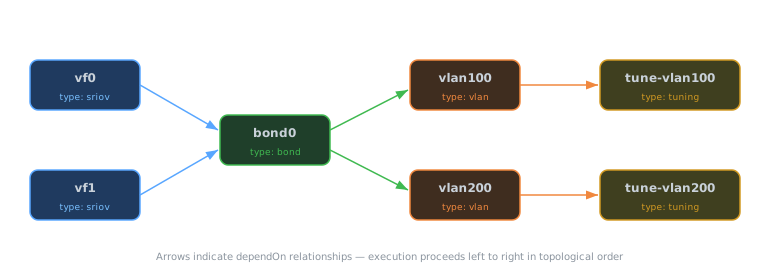
Diagram 1 — The dependOn DAG: VFs → Bond → VLANs → Tuning
Each step can declare dependOn: [<step-name>, ...]. This creates the DAG:
     vf0 ──┐
            ├── bond0 ──┬── vlan100 ── tune-vlan100
     vf1 ──┘            └── vlan200 ── tune-vlan200
The driver topologically sorts the DAG to determine execution order and
merges prevResult from all dependencies before passing it to each step.
2.3 Parameterized config — referencing CNI results
The config block of each step is the CNI plugin configuration that gets
passed to the binary. Values can contain parameter references of the form
{{ <stepName>.<field> }} that the driver resolves at execution time from the
CNI result (StepResult) of the referenced step.
Available fields follow the CNI ADD success result type. For plugins that produce network interfaces (sriov, bond, vlan, tuning):
| Reference | Resolves to |
|---|---|
{{ <step>.interfaceName }} | The name of the last interface in <step>’s result.interfaces[] |
{{ <step>.mac }} | The mac of the last interface in <step>’s result.interfaces[] |
{{ <step>.sandbox }} | The sandbox path from <step>’s result |
{{ <step>.ips[N].address }} | The Nth IP address from <step>’s result.ips[] |
{{ <step>.interfaces }} | The full interfaces[] array (used by bond to know which interfaces to enslave) |
For plugins that produce device nodes instead of interfaces (vfio-pci, rdma):
| Reference | Resolves to |
|---|---|
{{ <step>.pciAddress }} | The PCI BDF address of the device (e.g. "0000:03:00.2") |
{{ <step>.iommuGroup }} | The IOMMU group number |
{{ <step>.deviceNodes }} | The list of character device paths (e.g. ["/dev/vfio/42"]) |
{{ <step>.rdmaDevice }} | The RDMA link device name (e.g. "mlx5_0") |
The driver processes these just before invoking each CNI binary: it walks
the config JSON, finds all {{ ... }} tokens, looks up the referenced step’s
StepResult (which has already executed because of topological ordering), and
substitutes the value.
2.4 CRD definition
apiVersion: networking.dra.io/v1alpha1
kind: NetworkTopology
metadata:
  name: bonded-vlan-topology
spec:
  steps:
    # --- Root steps (no dependOn): DRA device allocations ---
    # type = CNI binary used to attach the device (e.g. sriov, host-device)
    - name: vf0
      type: sriov
      selector:
        cel: >-
          device.driver == "dra.networking" &&
          device.attributes["dra.networking"].pfName == "enp3s0f0" &&
          device.attributes["dra.networking"].rdma == true
      config:
        vlan: 0
        spoofchk: "off"
        trust: "on"

    - name: vf1
      type: sriov
      selector:
        cel: >-
          device.driver == "dra.networking" &&
          device.attributes["dra.networking"].pfName == "enp3s0f1" &&
          device.attributes["dra.networking"].rdma == true
      config:
        vlan: 0
        spoofchk: "off"
        trust: "on"

    # --- Derived steps (have dependOn): CNI plugin calls ---
    # type = CNI binary to invoke (bond, vlan, tuning, macvlan, etc.)
    # config values can use {{ stepName.field }} to reference CNI results

    - name: bond0
      type: bond
      dependOn: [vf0, vf1]
      config:
        name: bond0
        mode: 802.3ad
        xmitHashPolicy: layer3+4
        miimon: 100
        lacpRate: fast
        links:                                    # slave interfaces
          - name: "{{ vf0.interfaceName }}"       # resolves to "net1"
          - name: "{{ vf1.interfaceName }}"       # resolves to "net2"

    - name: vlan100
      type: vlan
      dependOn: [bond0]
      config:
        id: 100
        master: "{{ bond0.interfaceName }}"       # resolves to "bond0"
        name: data0

    - name: vlan200
      type: vlan
      dependOn: [bond0]
      config:
        id: 200
        master: "{{ bond0.interfaceName }}"       # resolves to "bond0"
        name: mgmt0

    - name: tune-vlan100
      type: tuning
      dependOn: [vlan100]
      config:
        dev: "{{ vlan100.interfaceName }}"      # resolves to "data0"
        mtu: 9000
        addresses:
          - "10.100.0.5/24"
        routes:
          - destination: "10.100.0.0/16"
            gateway: "10.100.0.1"
        ethtool:
          features:
            rx-checksum: true
            tcp-segmentation-offload: true

    - name: tune-vlan200
      type: tuning
      dependOn: [vlan200]
      config:
        dev: "{{ vlan200.interfaceName }}"      # resolves to "mgmt0"
        mtu: 1500
        addresses:
          - "10.200.0.5/24"
        routes:
          - destination: "0.0.0.0/0"
            gateway: "10.200.0.1"
3. Step Result Model (inspired by CNI)
The CNI specification defines a chaining
model where each plugin receives a prevResult from the previous plugin and
outputs a modified result. We adopt the same principle but extend it from a
linear chain to a DAG.
3.1 The result structure
Every step produces a StepResult, modelled after the CNI ADD success type:
{
  "interfaces": [
    {
      "name": "net1",
      "mac": "52:54:00:12:34:56",
      "sandbox": "/var/run/netns/<pod>",
      "pciID": "0000:03:00.2"
    }
  ],
  "ips": [
    {
      "address": "10.100.0.5/24",
      "gateway": "10.100.0.1",
      "interface": 0
    }
  ],
  "routes": [
    {
      "dst": "10.100.0.0/16",
      "gw": "10.100.0.1"
    }
  ]
}
3.2 How prevResult flows through the DAG
In CNI’s linear chain, each plugin receives the single prevResult from the
previous plugin. In a DAG the step may have multiple dependencies, so the
driver merges their results before passing them.
The prevResult provides two things:
- The
prevResultJSON — passed to the CNI binary via stdin (standard CNI protocol). The plugin can inspect it to discover existing interfaces. - The parameter reference namespace —
{{ stepName.field }}expressions in the step’sconfigare resolved from the dependency’s StepResult before the CNI binary is invoked. This is how the bond knows its slave names and the VLAN knows its parent name.
| Scenario | prevResult construction | Parameter references available |
|---|---|---|
| No dependency (root step) | No prevResult — the CNI binary starts fresh (first plugin in chain) | None — root steps don’t reference other steps |
| One dependency (e.g. vlan100 depends on bond0) | prevResult = bond0’s StepResult verbatim (identical to CNI) | {{ bond0.interfaceName }}, {{ bond0.mac }}, etc. |
| Multiple dependencies (e.g. bond0 depends on vf0 + vf1) | prevResult.interfaces = concatenation of all dependency interfaces[] lists, in dependOn declaration order | {{ vf0.interfaceName }}, {{ vf1.interfaceName }}, etc. — each dependency’s result is independently addressable |
3.3 Walkthrough: bond receives two VF results
After vf0 and vf1 execute (CNI ADD sriov), they each produce one
interface entry:
vf0 StepResult:
{
  "interfaces": [
    { "name": "net1", "mac": "52:54:00:aa:bb:01", "sandbox": "/var/run/netns/pod-abc" }
  ]
}
vf1 StepResult:
{
  "interfaces": [
    { "name": "net2", "mac": "52:54:00:aa:bb:02", "sandbox": "/var/run/netns/pod-abc" }
  ]
}
The driver prepares the bond0 step:
Resolve parameter references in bond0’s config:
{{ vf0.interfaceName }}→"net1"(last interface in vf0’s result){{ vf1.interfaceName }}→"net2"(last interface in vf1’s result)- The config
linksbecomes[{name: "net1"}, {name: "net2"}]
Build merged
prevResultfrom both dependencies:
{
  "interfaces": [
    { "name": "net1", "mac": "52:54:00:aa:bb:01", "sandbox": "/var/run/netns/pod-abc" },
    { "name": "net2", "mac": "52:54:00:aa:bb:02", "sandbox": "/var/run/netns/pod-abc" }
  ]
}- Invoke CNI ADD
bondwith the resolved config +prevResult.
The bond CNI plugin creates bond0, enslaves net1 and net2, and returns:
{
  "interfaces": [
    { "name": "net1", "mac": "52:54:00:aa:bb:01", "sandbox": "/var/run/netns/pod-abc" },
    { "name": "net2", "mac": "52:54:00:aa:bb:02", "sandbox": "/var/run/netns/pod-abc" },
    { "name": "bond0", "mac": "52:54:00:aa:bb:01", "sandbox": "/var/run/netns/pod-abc" }
  ]
}
This becomes bond0’s StepResult. {{ bond0.interfaceName }} now
resolves to "bond0" (the last entry in interfaces[]).
3.4 Walkthrough: VLANs reference the bond interface
The vlan100 step depends on bond0. The driver:
- Resolves
{{ bond0.interfaceName }}→"bond0"in the config:master: "bond0",name: "data0" - Sets
prevResult= bond0’s StepResult. - Invokes CNI ADD
vlan.
The vlan CNI plugin creates data0 (VLAN 100) on parent bond0 and returns:
vlan100 StepResult:
{
  "interfaces": [
    { "name": "net1", "mac": "52:54:00:aa:bb:01", "sandbox": "/var/run/netns/pod-abc" },
    { "name": "net2", "mac": "52:54:00:aa:bb:02", "sandbox": "/var/run/netns/pod-abc" },
    { "name": "bond0", "mac": "52:54:00:aa:bb:01", "sandbox": "/var/run/netns/pod-abc" },
    { "name": "data0", "mac": "52:54:00:aa:bb:01", "sandbox": "/var/run/netns/pod-abc" }
  ]
}
{{ vlan100.interfaceName }} now resolves to "data0".
The vlan200 step follows the same pattern independently (also depends
on bond0):
vlan200 StepResult:
{
  "interfaces": [
    { "name": "net1", "mac": "52:54:00:aa:bb:01", "sandbox": "/var/run/netns/pod-abc" },
    { "name": "net2", "mac": "52:54:00:aa:bb:02", "sandbox": "/var/run/netns/pod-abc" },
    { "name": "bond0", "mac": "52:54:00:aa:bb:01", "sandbox": "/var/run/netns/pod-abc" },
    { "name": "mgmt0", "mac": "52:54:00:aa:bb:01", "sandbox": "/var/run/netns/pod-abc" }
  ]
}
{{ vlan200.interfaceName }} now resolves to "mgmt0".
3.5 Walkthrough: tuning references the VLAN interface
tune-vlan100 depends on vlan100. The driver:
- Resolves
{{ vlan100.interfaceName }}→"data0"in the config:dev: "data0". - Sets
prevResult= vlan100’s StepResult. - Invokes CNI ADD
tuning.
The tuning plugin sets MTU 9000, adds 10.100.0.5/24, adds routes on
data0, and outputs the result with ips and routes populated:
{
  "interfaces": [
    { "name": "net1", "mac": "52:54:00:aa:bb:01", "sandbox": "/var/run/netns/pod-abc" },
    { "name": "net2", "mac": "52:54:00:aa:bb:02", "sandbox": "/var/run/netns/pod-abc" },
    { "name": "bond0", "mac": "52:54:00:aa:bb:01", "sandbox": "/var/run/netns/pod-abc" },
    { "name": "data0", "mac": "52:54:00:aa:bb:01", "sandbox": "/var/run/netns/pod-abc", "mtu": 9000 }
  ],
  "ips": [
    { "address": "10.100.0.5/24", "gateway": "10.100.0.1", "interface": 3 }
  ],
  "routes": [
    { "dst": "10.100.0.0/16", "gw": "10.100.0.1" }
  ]
}
The
"interface": 3index points todata0in the interfaces array, following the same convention as CNI.
4. From NetworkTopology to DRA Objects
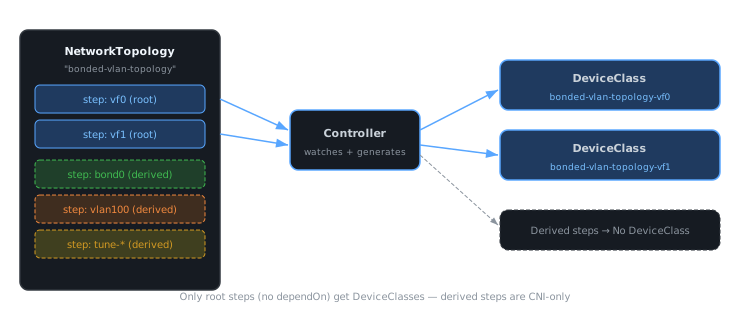
Diagram 2 — NetworkTopology → DRA Objects Generation Flow
A controller watches NetworkTopology resources and generates the
corresponding DRA objects. No changes to the DRA API are needed — everything
is expressed through existing fields.
4.1 DeviceClass generation
For every root step (a step with no dependOn), the controller creates a
DeviceClass. The step’s selector.cel expression is copied into the
DeviceClass’s spec.selectors[].
NetworkTopology "bonded-vlan-topology"
  step vf0 (type: sriov, no dependOn)   ──►  DeviceClass "bonded-vlan-topology-vf0"
  step vf1 (type: sriov, no dependOn)   ──►  DeviceClass "bonded-vlan-topology-vf1"
  step bond0 (type: bond, dependOn)     ──►  (no DeviceClass — CNI call only)
  step vlan100 (type: vlan, dependOn)   ──►  (no DeviceClass — CNI call only)
  ...
The generated DeviceClass for vf0 — note the config block carries the
networkTopologyRef and the step name so the DRA driver knows what to do:
apiVersion: resource.k8s.io/v1
kind: DeviceClass
metadata:
  name: bonded-vlan-topology-vf0
  labels:
    networking.dra.io/topology: bonded-vlan-topology
    networking.dra.io/step: vf0
spec:
  selectors:
    - cel:
        expression: >-
          device.driver == "dra.networking" &&
          device.attributes["dra.networking"].pfName == "enp3s0f0" &&
          device.attributes["dra.networking"].rdma == true
  # The opaque config is baked into the DeviceClass by the controller.
  # Every device allocated through this class automatically carries the
  # topology reference — the user never needs to set it.
  config:
    - opaque:
        driver: dra.networking
        parameters:
          networkTopologyRef:
            name: bonded-vlan-topology
          step: vf0
The controller generates an identical DeviceClass for vf1 (with step: vf1
and the corresponding CEL selector).
4.2 What the user writes
Because the networkTopologyRef is embedded in the DeviceClass, the user’s
ResourceClaim is completely clean — no opaque config, no topology
references. The user only needs to know the DeviceClass names:
apiVersion: resource.k8s.io/v1
kind: ResourceClaimTemplate
metadata:
  name: my-network
spec:
  spec:
    devices:
      requests:
        - name: vf0
          exactly:
            deviceClassName: bonded-vlan-topology-vf0
        - name: vf1
          exactly:
            deviceClassName: bonded-vlan-topology-vf1
That’s it. No opaque config, no networkTopologyRef, no knowledge of bonds
or VLANs. The platform admin encapsulated all of that in the NetworkTopology
and the generated DeviceClasses.
To add a GPU with PCIe co-location, the user simply adds a request and a constraint:
requests:
  - name: gpu
    exactly:
      deviceClassName: nvidia-gpu-h100
  - name: vf0
    exactly:
      deviceClassName: bonded-vlan-topology-vf0
  - name: vf1
    exactly:
      deviceClassName: bonded-vlan-topology-vf1
constraints:
  - matchAttribute: device.k8s.io/pcieRoot
    requests: [gpu, vf0, vf1]
4.3 How the DRA driver reconstructs the topology
When the DRA driver receives the allocation during NodePrepareResources,
each allocated device carries the opaque config from its DeviceClass. The
driver:
- Collects all opaque configs with
driver: dra.networking. - Groups them by
networkTopologyRef.name— all devices pointing to the same NetworkTopology are part of the same chain. - Fetches the
NetworkTopologyCR. - Maps each allocated device to its root step using the
stepfield from the opaque config (e.g. device frombonded-vlan-topology-vf0→ stepvf0). - Builds the full DAG, resolves parameter references, and executes the CNI chain in topological order.
4.4 Why only root steps get DeviceClasses
Root steps (no
dependOn) allocate real hardware. They need to go through the scheduler, which means they need DeviceClasses and ResourceSlice matching. The CEL selector on the root step is exactly what the DeviceClass needs. Thetypefield names the CNI binary that attaches the allocated device (e.g.sriovmoves a VF into the pod netns,host-devicemoves a whole PF).Derived steps (have
dependOn) are pure node-local CNI plugin calls. They don’t consume devices from ResourceSlices — the scheduler doesn’t need to know about them. Thetypefield names the CNI binary that performs the configuration (e.g.bondcreates a bond,vlancreates a sub-interface,tuningsets sysctls and ethtool features).
5. DeviceClass Design for Mixed NICs + GPUs
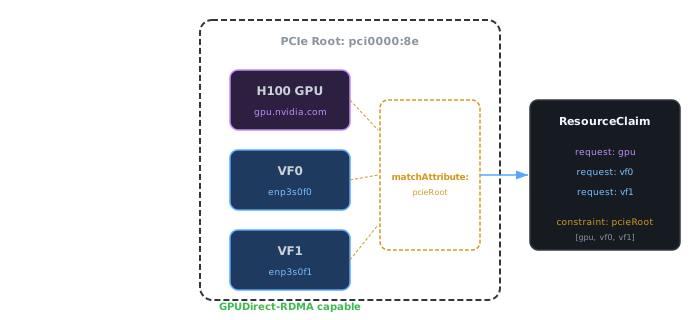
Diagram 3 — GPU + NIC PCIe Co-location via matchAttribute
For AI workloads, we need GPUs and NICs on the same PCIe root complex.
Both the NVIDIA GPU DRA driver and the network DRA driver already publish the
standard attribute device.k8s.io/pcieRoot on their ResourceSlices.
The existing DRA API supports this through constraints[].matchAttribute
in the ResourceClaim — no API extensions needed.
How it works
- The GPU DeviceClass is created separately (by NVIDIA or the platform team), selecting GPU devices.
- The NIC DeviceClasses are generated from the NetworkTopology’s root steps.
- The ResourceClaim contains requests for both GPU and NICs, with a
matchAttributeconstraint ondevice.k8s.io/pcieRootacross them.
The scheduler evaluates both drivers’ ResourceSlices and finds a node where a GPU and both VFs share the same PCIe root — all before pod placement.
The GPU and the network topology live in a single ResourceClaim, which means the scheduler sees them atomically. This is possible because each request in the claim references a different DeviceClass, and different drivers can serve different requests within the same claim.
6. Full Example
6.1 NetworkTopology
apiVersion: networking.dra.io/v1alpha1
kind: NetworkTopology
metadata:
  name: ai-bonded-rdma
spec:
  steps:
    - name: vf0
      type: sriov
      selector:
        cel: >-
          device.driver == "dra.networking" &&
          device.attributes["dra.networking"].pfName == "enp3s0f0" &&
          device.attributes["dra.networking"].rdma == true
      config:
        vlan: 0
        spoofchk: "off"
        trust: "on"

    - name: vf1
      type: sriov
      selector:
        cel: >-
          device.driver == "dra.networking" &&
          device.attributes["dra.networking"].pfName == "enp3s0f1" &&
          device.attributes["dra.networking"].rdma == true
      config:
        vlan: 0
        spoofchk: "off"
        trust: "on"

    - name: bond0
      type: bond
      dependOn: [vf0, vf1]
      config:
        name: bond0
        mode: 802.3ad
        xmitHashPolicy: layer3+4
        miimon: 100
        lacpRate: fast
        links:
          - name: "{{ vf0.interfaceName }}"
          - name: "{{ vf1.interfaceName }}"

    - name: data-vlan
      type: vlan
      dependOn: [bond0]
      config:
        id: 100
        master: "{{ bond0.interfaceName }}"
        name: data0

    - name: mgmt-vlan
      type: vlan
      dependOn: [bond0]
      config:
        id: 200
        master: "{{ bond0.interfaceName }}"
        name: mgmt0

    - name: tune-data
      type: tuning
      dependOn: [data-vlan]
      config:
        dev: "{{ data-vlan.interfaceName }}"
        mtu: 9000
        addresses:
          - "10.100.0.5/24"
        routes:
          - destination: "10.100.0.0/16"
            gateway: "10.100.0.1"
        ethtool:
          features:
            tcp-segmentation-offload: true

    - name: tune-mgmt
      type: tuning
      dependOn: [mgmt-vlan]
      config:
        dev: "{{ mgmt-vlan.interfaceName }}"
        mtu: 1500
        addresses:
          - "10.200.0.5/24"
        routes:
          - destination: "0.0.0.0/0"
            gateway: "10.200.0.1"
6.2 Generated DeviceClasses (by controller)
The controller generates one DeviceClass per root step, with the
networkTopologyRef and step baked into the opaque config:
apiVersion: resource.k8s.io/v1
kind: DeviceClass
metadata:
  name: ai-bonded-rdma-vf0
  labels:
    networking.dra.io/topology: ai-bonded-rdma
    networking.dra.io/step: vf0
spec:
  selectors:
    - cel:
        expression: >-
          device.driver == "dra.networking" &&
          device.attributes["dra.networking"].pfName == "enp3s0f0" &&
          device.attributes["dra.networking"].rdma == true
  config:
    - opaque:
        driver: dra.networking
        parameters:
          networkTopologyRef:
            name: ai-bonded-rdma
          step: vf0
---
apiVersion: resource.k8s.io/v1
kind: DeviceClass
metadata:
  name: ai-bonded-rdma-vf1
  labels:
    networking.dra.io/topology: ai-bonded-rdma
    networking.dra.io/step: vf1
spec:
  selectors:
    - cel:
        expression: >-
          device.driver == "dra.networking" &&
          device.attributes["dra.networking"].pfName == "enp3s0f1" &&
          device.attributes["dra.networking"].rdma == true
  config:
    - opaque:
        driver: dra.networking
        parameters:
          networkTopologyRef:
            name: ai-bonded-rdma
          step: vf1
The GPU DeviceClass already exists (e.g. created by NVIDIA’s operator):
apiVersion: resource.k8s.io/v1
kind: DeviceClass
metadata:
  name: nvidia-gpu-h100
spec:
  selectors:
    - cel:
        expression: >-
          device.driver == "gpu.nvidia.com" &&
          device.attributes["gpu.nvidia.com"].productName == "H100"
6.3 ResourceClaimTemplate (user creates this)
The user’s claim is clean — no opaque config, no topology references. The user only needs to know the DeviceClass names:
apiVersion: resource.k8s.io/v1
kind: ResourceClaimTemplate
metadata:
  name: ai-gpu-bonded-rdma
spec:
  spec:
    devices:
      requests:
        # GPU — handled by NVIDIA DRA driver
        - name: gpu
          exactly:
            deviceClassName: nvidia-gpu-h100

        # NIC VFs — handled by network DRA driver
        - name: vf0
          exactly:
            deviceClassName: ai-bonded-rdma-vf0

        - name: vf1
          exactly:
            deviceClassName: ai-bonded-rdma-vf1

      # PCIe co-location: GPU + both VFs on the same PCIe root
      constraints:
        - matchAttribute: device.k8s.io/pcieRoot
          requests: [gpu, vf0, vf1]
6.4 Pod
apiVersion: v1
kind: Pod
metadata:
  name: ai-training
spec:
  resourceClaims:
    - name: accelerators
      resourceClaimTemplateName: ai-gpu-bonded-rdma
  containers:
    - name: train
      image: nvcr.io/nvidia/pytorch:24.05-py3
      resources:
        claims:
          - name: accelerators
6.5 What happens at runtime
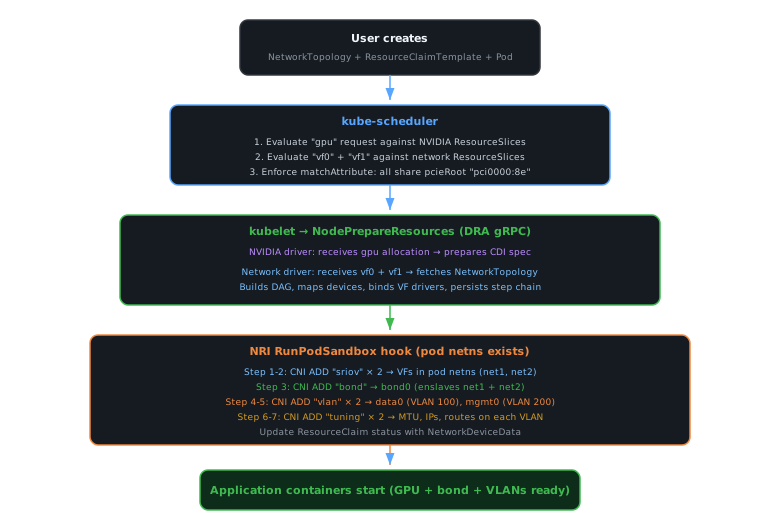
Diagram 4 — Architecture Overview: User → Scheduler → Kubelet → DRA Driver → NRI Hook
                      ┌─────────────────────────────────────────────────┐
  User creates:       │  NetworkTopology: ai-bonded-rdma                │
                      │  ResourceClaimTemplate: ai-gpu-bonded-rdma      │
                      │  Pod: ai-training                               │
                      └────────────────────┬────────────────────────────┘
                                           │
                                           ▼
  ┌───────────────────────────────────────────────────────────────────────┐
  │ kube-scheduler                                                       │
  │                                                                      │
  │  1. Evaluate "gpu" request against NVIDIA ResourceSlices             │
  │  2. Evaluate "vf0" request against network ResourceSlices            │
  │  3. Evaluate "vf1" request against network ResourceSlices            │
  │  4. Enforce matchAttribute: all three share pcieRoot "pci0000:8e"    │
  │  5. Pick node, write AllocationResult                                │
  └──────────────────────────────────┬────────────────────────────────────┘
                                     │
                                     ▼
  ┌───────────────────────────────────────────────────────────────────────┐
  │ kubelet → NodePrepareResources (DRA gRPC)                            │
  │                                                                      │
  │  NVIDIA driver: receives gpu allocation → prepares CDI spec          │
  │                                                                      │
  │  Network driver: receives vf0 + vf1 allocations + opaque config      │
  │    1. Read networkTopologyRef → fetch NetworkTopology "ai-bonded-rdma"│
  │    2. Build DAG: vf0,vf1 → bond0 → vlan100,vlan200 → tune-*         │
  │    3. Map allocated devices: vf0 → enp3s0f0v2, vf1 → enp3s0f1v2     │
  │    4. Bind VF drivers, generate CDI specs                            │
  │    5. Persist full step chain to checkpoint store                     │
  └──────────────────────────────────┬────────────────────────────────────┘
                                     │
                                     ▼
  ┌───────────────────────────────────────────────────────────────────────┐
  │ NRI RunPodSandbox hook (pod netns exists)                            │
  │                                                                      │
  │  Step 1 — vf0:  CNI ADD "sriov" (deviceID=0000:03:00.2)             │
  │    sriov plugin: moves VF into pod netns, renames to net1            │
  │    result: interfaces=[{name:net1, mac:..., sandbox:...}]            │
  │                                                                      │
  │  Step 2 — vf1:  CNI ADD "sriov" (deviceID=0000:03:01.2)             │
  │    sriov plugin: moves VF into pod netns, renames to net2            │
  │    result: interfaces=[{name:net2, mac:..., sandbox:...}]            │
  │                                                                      │
  │  Step 3 — bond0: CNI ADD "bond"                                      │
  │    prevResult = merge(vf0.result, vf1.result)                        │
  │    → receives interfaces: [{name:net1,...}, {name:net2,...}]          │
  │    bond plugin: creates bond0, enslaves net1 + net2                  │
  │    result: interfaces=[..., {name:bond0,...}]                         │
  │                                                                      │
  │  Step 4 — data-vlan: CNI ADD "vlan"                                  │
  │    prevResult = bond0.result                                         │
  │    → parent = last interface = "bond0"                               │
  │    vlan plugin: creates data0 (VLAN 100) on bond0                    │
  │    result: interfaces=[..., {name:data0,...}]                         │
  │                                                                      │
  │  Step 5 — mgmt-vlan: CNI ADD "vlan"                                  │
  │    prevResult = bond0.result                                         │
  │    → parent = last interface = "bond0"                               │
  │    vlan plugin: creates mgmt0 (VLAN 200) on bond0                    │
  │    result: interfaces=[..., {name:mgmt0,...}]                         │
  │                                                                      │
  │  Step 6 — tune-data: CNI ADD "tuning"                                │
  │    prevResult = data-vlan.result                                     │
  │    tuning plugin: sets MTU 9000, adds 10.100.0.5/24, adds routes     │
  │                                                                      │
  │  Step 7 — tune-mgmt: CNI ADD "tuning"                                │
  │    prevResult = mgmt-vlan.result                                     │
  │    tuning plugin: sets MTU 1500, adds 10.200.0.5/24, default route   │
  │                                                                      │
  │  Update ResourceClaim status with per-device NetworkDeviceData       │
  └──────────────────────────────────┬────────────────────────────────────┘
                                     │
                                     ▼
  ┌───────────────────────────────────────────────────────────────────────┐
  │ Application containers start                                         │
  │                                                                      │
  │  Pod sees:                                                           │
  │    /dev/nvidia0       ← GPU (from NVIDIA DRA driver)                 │
  │    net1, net2         ← VF interfaces (bond slaves)                  │
  │    bond0              ← LACP bond                                    │
  │    data0 (VLAN 100)   ← 10.100.0.5/24, MTU 9000                     │
  │    mgmt0 (VLAN 200)   ← 10.200.0.5/24, MTU 1500                     │
  │                                                                      │
  │  GPU and NICs share PCIe root pci0000:8e → GPUDirect-RDMA capable    │
  └───────────────────────────────────────────────────────────────────────┘
7. DRA Driver Orchestration Flow
7.1 Phase 1: NodePrepareResources
- Receive the
AllocationResultfrom kubelet. - For each opaque config block with a
networkTopologyRef, fetch theNetworkTopologyCR from the API server. - Build the step DAG from
spec.steps[]and theirdependOnfields. Validate: no cycles, all references valid. - For each root step (no
dependOn), map the DRA-allocated device to the step by request name: the ResourceClaim request namedvf0allocated device X → root stepvf0gets device X. - For each root step: bind the VF driver (kernel / vfio-pci), generate CDI spec entries.
- Persist the full step chain (DAG + configs + device mappings) to the checkpoint store, keyed by pod UID.
7.2 Phase 2: NRI RunPodSandbox
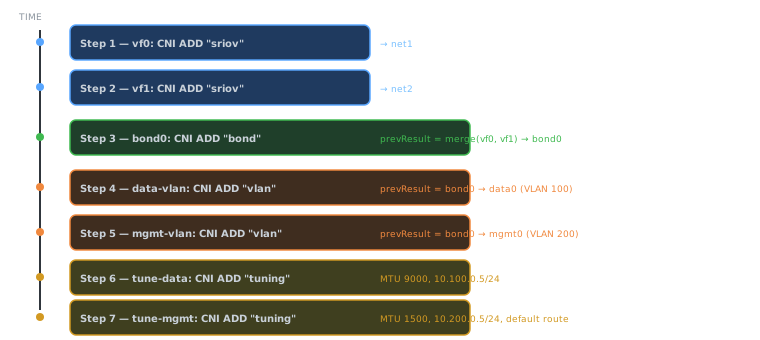
Diagram 5 — CNI Chain Execution Timeline
Pod sandbox is created by the container runtime. NRI hook fires.
Load the persisted step chain for this pod UID.
Topologically sort all steps.
Execute each step in order. Every step is a CNI binary invocation:
Step CNI binary ( type)CNI_COMMAND Input Output ( prevResultfor next step)Root (e.g. vf0)sriovADD Config with deviceID(PCI address of the allocated VF)interfaces[]with the VF attached in pod netnsRoot (e.g. vf1)sriovADD Config with deviceIDinterfaces[]with the VF attached in pod netnsbond0bondADD prevResult= mergedinterfaces[]from vf0 + vf1interfaces[]with bond appendedvlan100vlanADD prevResult= bond0’s resultinterfaces[]with VLAN appendedtune-vlan100tuningADD prevResult= vlan100’s resultinterfaces[]with modified attrs, plusips[]androutes[]For each invocation the driver:
- Builds the CNI config JSON from the step’s
configblock, injectingcniVersion,name,type, and (for root steps)runtimeConfig.deviceID. - Sets
prevResultfrom the merged dependency results. - Calls the CNI binary via
libcni(usingchroot /proc/1/rootfor host filesystem access, same pattern asdra-driver-sriov). - Captures the CNI result as the step’s
StepResult.
- Builds the CNI config JSON from the step’s
After each step, store its StepResult.
After all steps complete, update the
ResourceClaimstatus withNetworkDeviceDatafor each configured interface.
7.3 Rollback
If any step fails, the driver calls CNI_COMMAND=DEL on all completed steps
in reverse topological order (matching the CNI delete protocol):
- Tuning steps:
DEL(undo sysctls, remove IPs/routes). - VLAN steps:
DEL(remove sub-interface). - Bond steps:
DEL(destroy bond, releases slaves). - Root steps:
DEL(move device back to host netns). - Update ResourceClaim status with failure reason on the failing step.
8. Validation: Claim ↔ NetworkTopology Mismatch
The user owns the ResourceClaim (so they can freely add GPU requests, cross-device constraints, etc.). The controller only generates DeviceClasses from the NetworkTopology’s root steps. This means the user could submit a claim that references a NetworkTopology but is missing one or more root step requests.
Two enforcement points catch this — a webhook for fast feedback and the driver as a safety net.
8.1 Validating Admission Webhook
The network DRA driver deploys a validating webhook on ResourceClaim and
ResourceClaimTemplate create/update. When any opaque config block contains a
networkTopologyRef, the webhook:
- Fetches the referenced
NetworkTopologyCR. - Collects all root step names (steps with no
dependOn). - Collects all request names in the claim whose opaque config carries the
same
networkTopologyRef. - Compares the two sets.
If there is a mismatch the webhook rejects the request:
admission webhook "validate.networking.dra.io" denied the request:
  NetworkTopology "ai-bonded-rdma" requires root step requests [vf0, vf1],
  but ResourceClaimTemplate "ai-gpu-bonded-rdma" only provides requests [vf0].
  Missing: [vf1]
The user gets immediate feedback at kubectl apply time — before a pod is
even created. Crucially the webhook only validates that the network root steps
are present; it ignores any additional requests (e.g. GPU) since those
belong to other drivers.
8.2 DRA Driver at NodePrepareResources (safety net)
If the webhook is not installed, was temporarily unavailable, or is bypassed, the driver catches the mismatch at prepare time:
- Driver receives the
AllocationResultwith opaque config pointing tonetworkTopologyRef: ai-bonded-rdma. - Driver fetches the
NetworkTopology, builds the DAG, identifies root steps[vf0, vf1]. - Driver maps allocated devices to root steps by matching request names.
- Root step
vf1has no matching allocated device → driver returns an error fromNodePrepareResources.
The kubelet surfaces this as a pod event:
Warning  FailedPrepare  pod/ai-training
  NodePrepareResources failed: NetworkTopology "ai-bonded-rdma" root step "vf1"
  has no matching device request in ResourceClaim "ai-gpu-bonded-rdma".
  The ResourceClaim must contain a request named "vf1" with
  deviceClassName "ai-bonded-rdma-vf1".
The pod stays Pending and the user sees exactly what is missing.
8.3 Summary
| Enforcement Point | When | User Sees |
|---|---|---|
| Validating webhook | kubectl apply of the claim | Immediate rejection with missing request names |
| DRA driver | After scheduling, on the node | Pod event with failure reason, pod stays Pending |
9. Future: CNI Plugin Schema CRD (Plugin Self-Description)
Status: Optional / future implementation. Not required for the initial proposal but would significantly improve the user experience and enable compile-time-like validation of NetworkTopology DAGs.
9.1 Problem
Today, CNI plugins are opaque binaries. There is no machine-readable description of:
- What config parameters a plugin accepts (e.g. the
bondplugin acceptsmode,miimon,links; thevlanplugin acceptsid,master). - What input the plugin requires from
prevResult(e.g. thebondplugin requires at least 2 entries inprevResult.interfaces; thetuningplugin requires at least 1). - What output the plugin produces (e.g. the
bondplugin appends one interface; thevlanplugin appends one interface; thetuningplugin modifies an existing interface and may addips/routes).
Without this, the DRA driver can only validate the NetworkTopology DAG
structurally (no cycles, references exist) but cannot validate
semantically (will the bond actually get 2 interfaces? does the tuning
plugin understand the ethtool field?). Errors are discovered only at
runtime when the CNI binary fails.
9.2 The CNIPluginSchema CRD
Each CNI plugin vendor ships a CNIPluginSchema CR alongside the CNI
binary. It is a cluster-scoped CRD that describes the plugin’s contract:
apiVersion: cni.networking.k8s.io/v1alpha1
kind: CNIPluginSchema
metadata:
  name: bond
spec:
  # The CNI binary name (matches the `type` field in NetworkTopology steps)
  cniType: bond
  version: "1.0.0"

  # --- Config parameters accepted by this plugin ---
  configParameters:
    required:
      - name: mode
        type: string
        description: "Bond mode"
        enum: ["balance-rr", "active-backup", "balance-xor", "broadcast",
               "802.3ad", "balance-tlb", "balance-alb"]
      - name: links
        type: "[]object"
        description: "Slave interfaces to enslave"
        minItems: 2
        items:
          properties:
            name:
              type: string
              description: "Interface name (supports {{ step.interfaceName }} references)"
    optional:
      - name: name
        type: string
        description: "Name for the bond device"
        default: "bond0"
      - name: xmitHashPolicy
        type: string
        enum: ["layer2", "layer3+4", "layer2+3", "encap2+3", "encap3+4"]
      - name: miimon
        type: integer
        description: "Link monitoring interval in ms"
      - name: lacpRate
        type: string
        enum: ["slow", "fast"]

  # --- What this plugin requires from prevResult ---
  input:
    prevResult:
      required: true
      interfaces:
        minItems: 2                    # bond needs at least 2 slaves
        maxItems: 8                    # kernel BOND_MAX_SLAVES practical limit
      ips:
        required: false                # bond doesn't need IPs on input
      routes:
        required: false

  # --- What this plugin produces in its result ---
  output:
    interfaces:
      appends: 1                       # adds exactly one interface (the bond)
      passthrough: true                # also passes through all input interfaces
    ips:
      passthrough: true                # passes through any existing IPs
    routes:
passthrough: trueapiVersion: cni.networking.k8s.io/v1alpha1
kind: CNIPluginSchema
metadata:
name: vlan
spec:
cniType: vlan
version: "1.0.0"
configParameters:
required:
- name: id
type: integer
description: "VLAN ID"
minimum: 1
maximum: 4094
- name: master
type: string
description: "Parent interface (supports {{ step.interfaceName }} references)"
optional:
- name: name
type: string
description: "Name for the VLAN sub-interface"
input:
prevResult:
required: true
interfaces:
minItems: 1 # needs at least the parent interface
output:
interfaces:
appends: 1 # adds the VLAN sub-interface
passthrough: true
ips:
passthrough: true
routes:
passthrough: trueapiVersion: cni.networking.k8s.io/v1alpha1
kind: CNIPluginSchema
metadata:
name: sriov
spec:
cniType: sriov
version: "1.0.0"
configParameters:
required: []
optional:
- name: vlan
type: integer
minimum: 0
maximum: 4094
- name: spoofchk
type: string
enum: ["on", "off"]
- name: trust
type: string
enum: ["on", "off"]
- name: mac
type: string
# Root plugin — no prevResult needed
input:
prevResult:
required: false
output:
interfaces:
appends: 1 # the VF moved into the pod netns
passthrough: false # root plugin, nothing to pass through
ips:
passthrough: false
routes:
passthrough: falseNot all device plugins produce network interfaces. A VFIO-PCI plugin
binds the VF to the vfio-pci kernel driver and exposes it as character
device nodes (/dev/vfio/<group>) — there is no interfaces[] entry in
the result because the device is not a kernel netdev. The schema must be
able to express this:
apiVersion: cni.networking.k8s.io/v1alpha1
kind: CNIPluginSchema
metadata:
  name: vfio-pci
spec:
  cniType: vfio-pci
  version: "1.0.0"

  configParameters:
    required: []
    optional:
      - name: driver
        type: string
        description: "Kernel driver to bind (vfio-pci, igb_uio, uio_pci_generic)"
        enum: ["vfio-pci", "igb_uio", "uio_pci_generic"]
        default: "vfio-pci"

  input:
    prevResult:
      required: false

  # VFIO devices produce NO network interfaces — they expose device nodes
  output:
    interfaces:
      appends: 0
      passthrough: false
    ips:
      passthrough: false
    routes:
      passthrough: false
    # Device nodes exposed to the container via CDI
    devices:
      appends: true                    # produces /dev/vfio/<group>, /dev/vfio/vfio
      properties:
        - name: pciAddress
          type: string
          description: "PCI BDF address of the bound device"
        - name: iommuGroup
          type: string
          description: "IOMMU group number"
        - name: deviceNodes
          type: "[]string"
          description: "Paths to character devices (e.g. /dev/vfio/42)"
This has two important implications for DAG validation:
A VFIO step cannot be a dependency of bond/vlan/tuning — those plugins require
interfaces.minItems >= 1, butvfio-pciproducesinterfaces.appends: 0. The webhook rejects this at create time:admission webhook "validate.networking.dra.io" denied the request: NetworkTopology "bad-dpdk", step "bond0": CNIPluginSchema "bond" requires at least 2 interfaces in prevResult, but dependency "dpdk-vf" uses plugin "vfio-pci" which produces 0 interfaces. VFIO devices cannot be bonded — they are userspace-managed.A VFIO step can be a leaf in the DAG — it’s a root step that allocates a device and binds it to vfio-pci. No further CNI chaining is possible (or needed — DPDK apps manage the device from userspace).
Parameter references from VFIO steps use
devicesfields instead ofinterfacesfields:Reference Resolves to {{ dpdk-vf.pciAddress }}The PCI BDF address (e.g. "0000:03:00.2"){{ dpdk-vf.iommuGroup }}The IOMMU group (e.g. "42"){{ dpdk-vf.deviceNodes }}The device node paths
This also applies to other non-netdev attachment types like RDMA-only
devices (InfiniBand without ethernet) that expose /dev/infiniband/*
character devices but may not have a kernel network interface:
apiVersion: cni.networking.k8s.io/v1alpha1
kind: CNIPluginSchema
metadata:
  name: rdma
spec:
  cniType: rdma
  version: "1.0.0"

  configParameters:
    optional:
      - name: rdmaDevice
        type: string
        description: "RDMA device name (e.g. mlx5_0)"

  input:
    prevResult:
      required: false

  output:
    # RDMA devices may or may not have an associated network interface
    interfaces:
      appends: 0                       # no netdev for IB-only devices
      passthrough: false
      conditional: true                # may produce an interface for RoCE devices
    devices:
      appends: true
      properties:
        - name: rdmaDevice
          type: string
          description: "RDMA link device name (e.g. mlx5_0)"
        - name: deviceNodes
          type: "[]string"
description: "Character devices (/dev/infiniband/uverbs0, rdma_cm, etc.)"apiVersion: cni.networking.k8s.io/v1alpha1
kind: CNIPluginSchema
metadata:
name: tuning
spec:
cniType: tuning
version: "1.0.0"
configParameters:
required: []
optional:
- name: dev
type: string
description: "Target interface (supports {{ step.interfaceName }} references)"
- name: mtu
type: integer
- name: addresses
type: "[]string"
description: "IP addresses in CIDR notation"
- name: routes
type: "[]object"
items:
properties:
destination: { type: string }
gateway: { type: string }
- name: ethtool
type: object
properties:
features:
type: "map[string]bool"
- name: sysctl
type: "map[string]string"
input:
prevResult:
required: true
interfaces:
minItems: 1 # needs the interface to tune
output:
interfaces:
appends: 0 # doesn't create new interfaces
passthrough: true # passes through all existing
modifies: true # may change MTU, MAC on existing
ips:
appends: true # may add IPs
passthrough: true
routes:
appends: true # may add routes
passthrough: true9.3 Validation at NetworkTopology creation time
When the user creates or updates a NetworkTopology, the validating webhook
uses the CNIPluginSchema CRs to perform semantic DAG validation:
For each step, the webhook:
Looks up the
CNIPluginSchemamatching the step’stypefield. If not found, skip validation for that step (backward compatible with plugins that don’t ship a schema).Validates config parameters:
- All
requiredparameters are present in the step’sconfig. - No unknown parameters (unless the schema allows additional fields).
- Values match declared types, enums, min/max constraints.
{{ ref }}expressions are only used in fields of typestring.
- All
Validates input requirements against the DAG:
- If
input.prevResult.required: true, the step must have adependOn(cannot be a root step). - If
input.prevResult.interfaces.minItems: 2, the step must depend on steps whose combined output produces at least 2 interfaces. The webhook computes this by walking the DAG and summing up each dependency’soutput.interfaces.appends+ passthrough counts.
- If
Computes the step’s output for downstream validation:
- Number of interfaces = (input passthrough count) +
output.interfaces.appends - Whether
ips/routesare available for{{ ref }}expressions.
- Number of interfaces = (input passthrough count) +
Example validation error:
admission webhook "validate.networking.dra.io" denied the request:
  NetworkTopology "broken-topology", step "bond0":
    CNIPluginSchema "bond" requires at least 2 interfaces in prevResult,
    but step "bond0" depends on [vf0] which produces only 1 interface.
    Add another VF step to dependOn.
Another example — unknown config parameter:
admission webhook "validate.networking.dra.io" denied the request:
  NetworkTopology "bad-config", step "vlan100":
    CNIPluginSchema "vlan" does not accept parameter "vlanId".
    Did you mean "id"?
9.4 How plugin vendors ship the schema
Each CNI plugin is packaged as a Helm chart that deploys:
- A DaemonSet whose init container copies the CNI binary to the host and whose main container sleeps (keeps the DaemonSet alive for upgrades and node auto-scaling).
- The CNIPluginSchema CR applied as a Helm template.
cni-plugin-bond/                       # Helm chart
├── Chart.yaml
├── values.yaml
├── templates/
│   ├── daemonset.yaml                 # DaemonSet that installs the binary
│   └── cnipluginschema.yaml           # CNIPluginSchema CR
└── image/
    └── /opt/cni/bin/bond              # CNI binary inside the container image
The DaemonSet:
apiVersion: apps/v1
kind: DaemonSet
metadata:
  name: cni-plugin-bond
spec:
  selector:
    matchLabels:
      app: cni-plugin-bond
  template:
    spec:
      initContainers:
        - name: install
          image: registry.example.com/cni-plugins/bond:v1.0.0
          command: ["cp", "/opt/cni/bin/bond", "/host/opt/cni/bin/"]
          volumeMounts:
            - name: cni-bin
              mountPath: /host/opt/cni/bin
      containers:
        - name: wait
          image: registry.example.com/cni-plugins/bond:v1.0.0
          command: ["sleep", "infinity"]
      volumes:
        - name: cni-bin
          hostPath:
            path: /opt/cni/bin
helm install cni-bond ./cni-plugin-bond deploys the DaemonSet on every node
and applies the CNIPluginSchema CR to the cluster.
Future: DRA Network Operator
In the future, the manual Helm-per-plugin model can be replaced by a DRA Network Operator that manages plugin lifecycle declaratively:
apiVersion: networking.dra.io/v1alpha1
kind: CNIPlugin
metadata:
  name: bond
spec:
  image: registry.example.com/cni-plugins/bond:v1.0.0
  binaryPath: /opt/cni/bin/bond
The operator would:
- Deploy the DaemonSet automatically from the
CNIPluginCR. - Extract and apply the
CNIPluginSchemafrom the container image. - Handle upgrades (rolling binary replacement across nodes).
- Garbage-collect removed plugins (delete DaemonSet + schema).
- Report plugin health per node via status conditions.
9.5 Summary
| Aspect | Without CNIPluginSchema | With CNIPluginSchema |
|---|---|---|
| Config validation | Runtime failure (CNI binary returns error code 7) | Webhook rejects at kubectl apply time |
| DAG wiring validation | Runtime failure (e.g. bond gets 1 interface instead of 2) | Webhook computes interface counts across the DAG |
| Parameter discovery | Read plugin docs, trial and error | kubectl get cnipluginschema bond -o yaml |
| Typo detection | Runtime failure | Webhook suggests corrections |
| Backward compatibility | N/A | Plugins without a schema are not validated (pass-through) |
9b. Coexistence with OVN-Kubernetes (OKEP-6391)
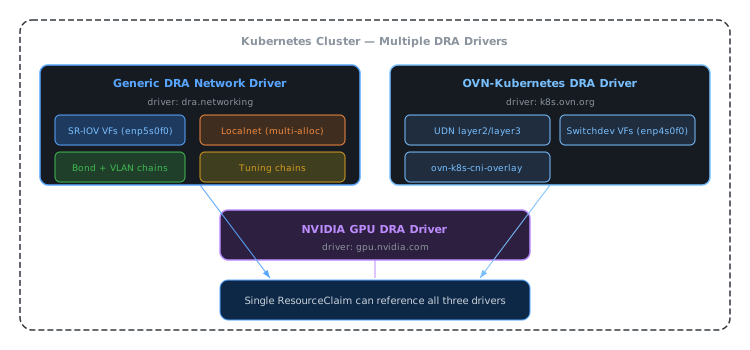
Diagram 6 — OVN-K Integration: UDN and Localnet Coexistence
OVN-Kubernetes is developing its own DRA driver (driver: k8s.ovn.org,
see OKEP-6391)
for first-party accelerated networking. Our generic DRA network driver
(driver: dra.networking) coexists cleanly because DRA natively supports
multiple drivers in the same cluster.
9b.1 OVN-K Network Types
OVN-K supports three secondary network topologies, all using
ovn-k8s-cni-overlay as the CNI binary:
| Topology | How pods connect | Device on host | DRA model |
|---|---|---|---|
| layer2 (UDN) | VF moved to pod (accelerated) or veth pair | Switchdev VF with representor on br-int | Exclusive VF per pod |
| layer3 (UDN) | Same as layer2 | Same | Exclusive VF per pod |
| localnet (CUDN) | veth pair | PF/bridge mapped via ovn-bridge-mappings | Shared underlay (multi-alloc) |
9b.2 Use Case A: UDN Secondary with GPU Co-location
The most natural integration: a single accelerated VF per pod for a UDN
secondary network, with matchAttribute for GPU co-location.
NetworkTopology
apiVersion: networking.dra.io/v1alpha1
kind: NetworkTopology
metadata:
  name: ovnk-udn-accelerated
spec:
  steps:
    - name: ovn-vf
      type: ovn-k8s-cni-overlay
      selector:
        cel: >-
          device.driver == "dra.networking" &&
          device.attributes["dra.networking"].type == "vf" &&
          device.attributes["dra.networking"].pfName == "enp5s0f0"
      config:
        topology: layer2
        role: secondary
        netAttachDefName: "default/tenant-blue"
        subnets: "172.31.0.0/24"
ResourceClaimTemplate with GPU co-location
apiVersion: resource.k8s.io/v1
kind: ResourceClaimTemplate
metadata:
  name: ai-ovnk-aligned
spec:
  spec:
    devices:
      requests:
        - name: gpu
          exactly:
            deviceClassName: nvidia-gpu-h100
        - name: ovn-vf
          exactly:
            deviceClassName: ovnk-udn-accelerated-ovn-vf
      constraints:
        - matchAttribute: device.k8s.io/pcieRoot
          requests: [gpu, ovn-vf]
The scheduler ensures the GPU and the OVN-K VF share the same PCIe root — optimal for GPUDirect-RDMA on the UDN secondary network.
9b.3 Use Case B: Localnet as Shared Device
Localnet networks map a logical switch to a physical network via OVS
bridge-mappings. Pods connect via veth pairs — the physical uplink stays
on the host. This maps to allowMultipleAllocations: true.
DeviceExposurePolicy
apiVersion: networking.dra.io/v1alpha1
kind: DeviceExposurePolicy
metadata:
  name: localnet-uplink
spec:
  priority: 150
  selector:
    cel: >-
      device.attributes["dra.networking"].type == "pf" &&
      device.attributes["dra.networking"].ifName == "enp6s0f0"
  action: expose
  exposure:
    deviceNameSuffix: "-localnet"
    allowMultipleAllocations: true
    capacity:
      connections:
        value: "128"
        requestPolicy:
          default: "1"
    supportedCNIPlugins:
      - name: ovn-k8s-cni-overlay
        exclusive: false
        consumePerAllocation:
          connections: 1
    additionalAttributes:
      "dra.networking/physicalNetworkName": "localnet1"
NetworkTopology
apiVersion: networking.dra.io/v1alpha1
kind: NetworkTopology
metadata:
  name: ovnk-localnet
spec:
  steps:
    - name: localnet-port
      type: ovn-k8s-cni-overlay
      selector:
        cel: >-
          device.driver == "dra.networking" &&
          device.attributes["dra.networking"].physicalNetworkName == "localnet1"
      config:
        topology: localnet
        role: secondary
        physicalNetworkName: "localnet1"
        netAttachDefName: "default/localnet-blue"
        subnets: "192.168.100.0/24"
        vlanID: 200
9b.4 Use Case C: Localnet + Tuning Chain
Chain a tuning step after localnet for MTU or sysctl settings:
apiVersion: networking.dra.io/v1alpha1
kind: NetworkTopology
metadata:
  name: ovnk-localnet-tuned
spec:
  steps:
    - name: localnet-port
      type: ovn-k8s-cni-overlay
      selector:
        cel: >-
          device.driver == "dra.networking" &&
          device.attributes["dra.networking"].physicalNetworkName == "localnet1"
      config:
        topology: localnet
        role: secondary
        physicalNetworkName: "localnet1"
        netAttachDefName: "default/localnet-blue"
        subnets: "192.168.100.0/24"

    - name: tune-localnet
      type: tuning
      dependOn: [localnet-port]
      config:
        dev: "{{ localnet-port.interfaceName }}"
        mtu: 9000
        sysctl:
          net.core.somaxconn: "512"
One root step (OVN-K creates veth + OVN plumbing) + one derived step (tuning sets MTU and sysctl) — the simplest chaining example.
9b.5 Preventing Driver Conflicts
When both drivers run on the same cluster, partition devices:
| Device | Managed by | How |
|---|---|---|
Switchdev VFs on enp5s0f0 | Our generic driver | DeviceExposurePolicy exposes them |
Switchdev VFs on enp4s0f0 | OVN-K’s driver | OVN-K publishes under k8s.ovn.org |
Localnet uplink enp6s0f0 | Our generic driver | DeviceExposurePolicy with allowMultipleAllocations |
Configure OVN-K to exclude our driver’s devices:
ovnkube-node --dra-filter='!("k8s.ovn.org/ifName" in attributes) || attributes["k8s.ovn.org/ifName"].StringValue != "enp5s0f0"'10. Open Questions
| # | Question | Notes |
|---|---|---|
| 1 | How to handle NetworkTopology updates while pods are running? | Likely immutable once referenced by a ResourceClaim. Controller rejects edits. |
| 2 | ResourceSlice and device discovery for the network DRA driver. | See companion document: DRA ResourceSlice Discovery Brainstorm |